- Free Estimates
- Fully Insured
- Local & Family-Friendly
- Serving Both Sides of the River
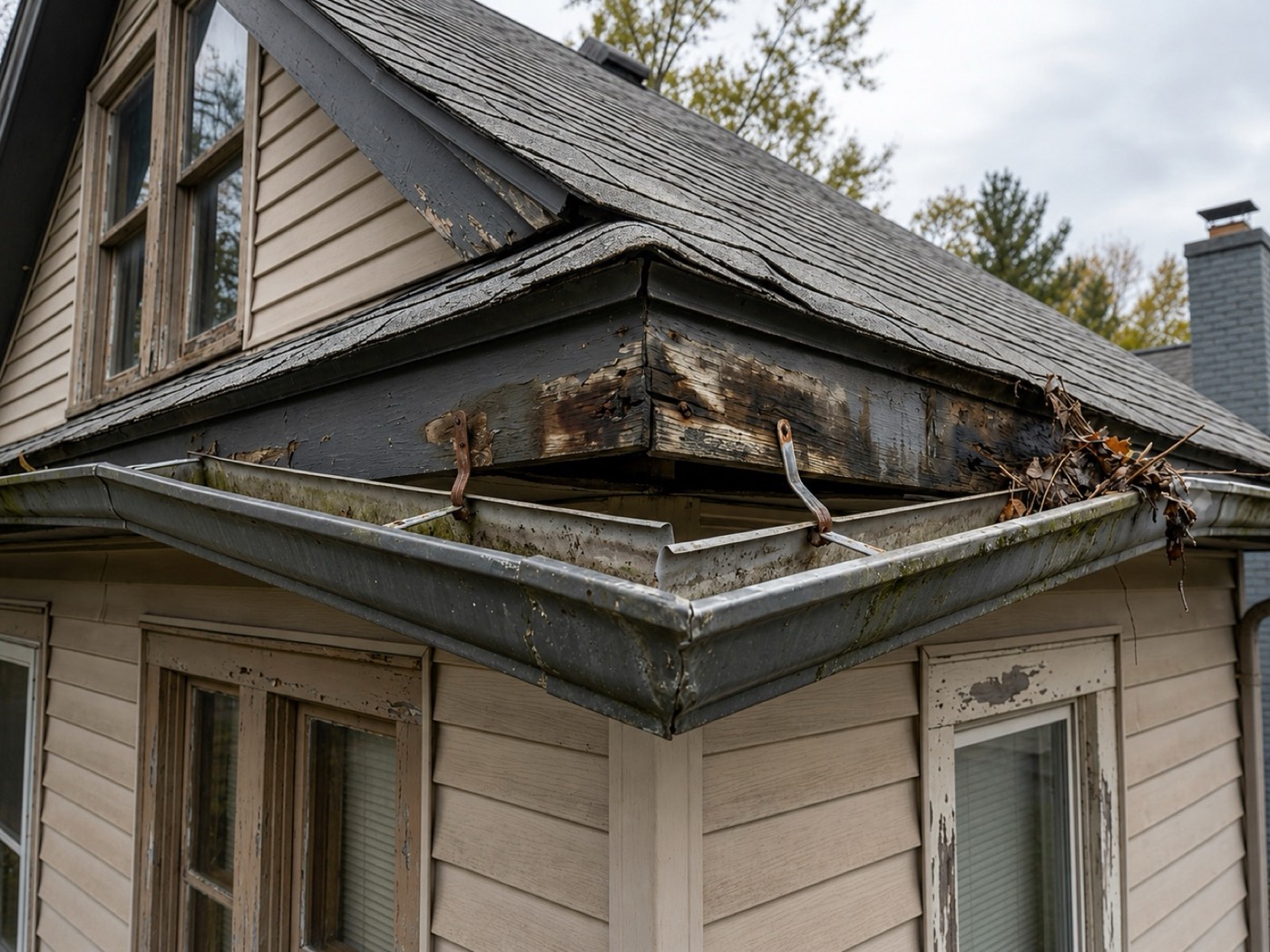
Gutters tend to fail quietly. By the time water is pouring over the edge in a storm, the problem has usually been building for a while. The good news is that gutters give you warning signs long before they fail completely, if you know what to look for. Here are five clear signals that your Quad Cities gutters need repair or replacement, plus how to tell which one you're facing.
1. Sagging gutters or sections pulling away from the house
Gutters should sit tight against the fascia in a straight line. If you see a run sagging in the middle or a section that's visibly pulled away from the house, water is pooling where it shouldn't, and pouring over the back edge, often right against your foundation. The usual culprits are old spike-and-ferrule fasteners working loose, the weight of water from a clog, or rotted fascia behind the gutter. Caught early, this is a straightforward repair: re-securing the run with heavy-duty hidden hangers and correcting the pitch.
2. Leaks, drips, and streaks at the seams
Sectional gutters and mitered corners are the most common places for leaks to start. Look for active drips during rain, rust or corrosion at the joints, and dark streaks running down the siding beneath a seam. A leak or two can often be sealed or the joint rebuilt. But if you're chasing new leaks every season, that's a sign the sectional system is reaching the end of its life, and a case for switching to seamless gutters, which have no mid-run joints to fail.
3. Water overflowing in every rainstorm
If water sheets over the front edge of the gutter during a normal Quad Cities downpour, something isn't draining. Sometimes it's a simple clog that a cleaning fixes. Other times it's improper pitch, undersized gutters, or downspouts that are too small or blocked. Persistent overflow after cleaning points to a repair or an upsizing job, not something to ignore, since that water is landing right where you don't want it.
4. Water in the basement, or eroded landscaping
Sometimes the clearest sign of a gutter problem shows up at ground level. Water in the basement after storms, eroded mulch and soil beneath the eaves, pooling near the foundation, or cracks appearing in the foundation can all trace back to gutters that aren't carrying water away from the house. Often the fix is downspout repair and re-routing drainage with extensions, restoring the gutters' whole reason for existing.
5. Peeling paint, rust, rot, or mildew
Chronic moisture leaves evidence. Peeling paint or mildew on the siding beneath a gutter, rust stains on the gutter itself, rotted fascia or soffit boards, and water marks on exterior walls all say water has been going where it shouldn't for a while. Surface issues may be repairable; if the fascia behind the gutter has rotted, that has to be addressed as part of the fix so the repair actually lasts.
Repair or replace? How to decide
Not every problem means new gutters. As a rule of thumb:
- Lean toward repair when the issues are localized, a sagging section, a couple of leaking seams, one bad downspout, and the rest of the system is sound.
- Lean toward replacement when gutters are widely rusted, leaking at joints throughout, badly undersized, or pulling away along most of their length. At that point, new seamless gutters usually cost less over time than an endless string of repairs.
Age matters too. Aluminum gutters commonly last 20 years or more, so a system that's already old and showing several of these signs is often better replaced than patched.
Why small gutter problems escalate fast
It's tempting to put off a minor gutter issue, but gutters fail in a chain reaction. One clog causes an overflow; the overflow rots the fascia; the rotted fascia can no longer hold the hangers; the gutter sags and pulls away; and now water is running straight down the wall and against the foundation. What began as a $0 fix, a handful of leaves, becomes fascia repair, re-hanging, and possibly foundation or basement water remediation. Acting on the first sign is almost always the cheapest moment to act.
How long should gutters last?
Well-installed seamless aluminum gutters commonly last 20 years or more in the Quad Cities, and copper far longer. Downspouts and hangers may need attention sooner. If your system is well within its lifespan and the problems are isolated, repair is usually the right call. If it's aging and showing several of the signs above at once, replacement tends to be the better long-term value, and a good installer will tell you honestly which situation you're in.
Get a straight answer for your home
Spotting one of these signs on your Quad Cities home? We'll take a look and give you an honest recommendation, repair or replace, with a free written estimate either way.
Call (563) 291-6305 or request a free estimate online today.